

Why Are There Several Dos on a Piano? Octaves and Registers Made Simple
A piano has several dos, res, and mis — they're just octaves apart. Here's how octaves and registers are split, and where each one lands on the staff.
Ask someone to play a do, and they might freeze for a second: the piano has several dos — so which one do you mean?
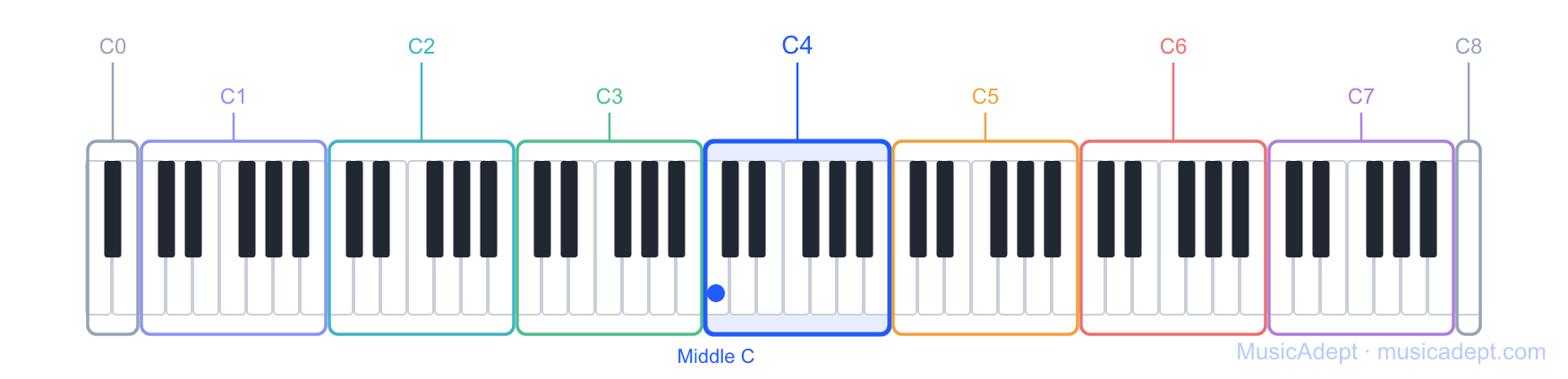
They're all do, really — just higher or lower, a whole number of octaves apart. Every seven white keys (1234567) you land on a new do, and each full run of 1234567 is one octave (also called a register).
To tell these repeating do-re-mi apart, every octave gets a name. In English the simplest system labels them by their C: middle C's octave is the C4 octave, the one above is C5, the one below is C3 — the number is just how far it sits from the middle.
Can't yet read notes on the staff at a glance? Start with the previous piece: Read Music in 5 Minutes: Lock In 3 Notes (6, 1, 3) and Decode Every Note on the Staff. From here on, we'll assume you can already find 6, 1, and 3.
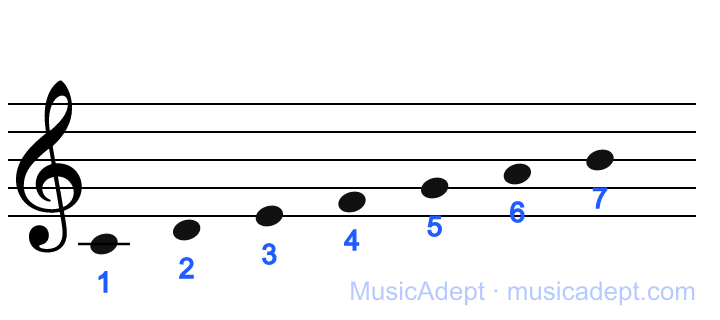
The C4 octave (around middle C)
Start at middle C and count up to 7 (B4) — that run is the C4 octave.
Its 1 (C4) sits on the first ledger line below the treble staff: the middle C everyone knows. Most nursery rhymes and pop hooks live right here — the most common, most important range.
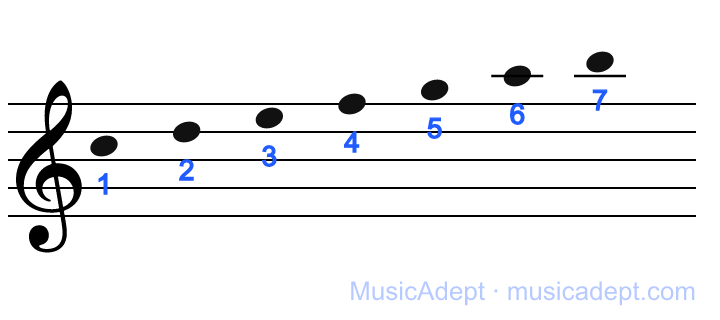
The C5 octave (one octave up)
Step up from the 7 of the C4 octave to a new 1 — now you're in the C5 octave.
The whole run sits inside the treble staff: its 1 (C5) is the third space — the same 1 from the "treble 6, 1, 3." The violin's bright highs and a soprano's common range live here.
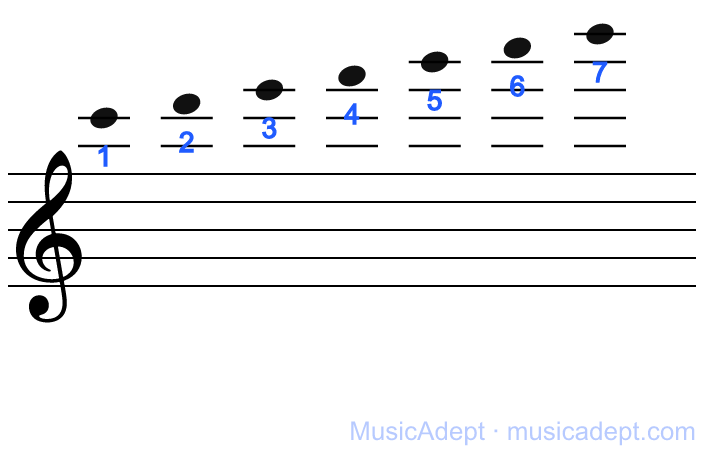
The C6 octave (up onto ledger lines)
Keep climbing and the staff runs out of room — time for ledger lines.
This is the C6 octave; its 1 (C6) is the second ledger line above. It sounds bright and crisp; the flute's high notes often sit here.
The C3 octave (one octave below middle C)
Count one octave down from middle C and you reach the C3 octave.
The whole run sits in the bass staff: its 1 (C3) is the second space. The baritone voice and the cello's melodies often live here.
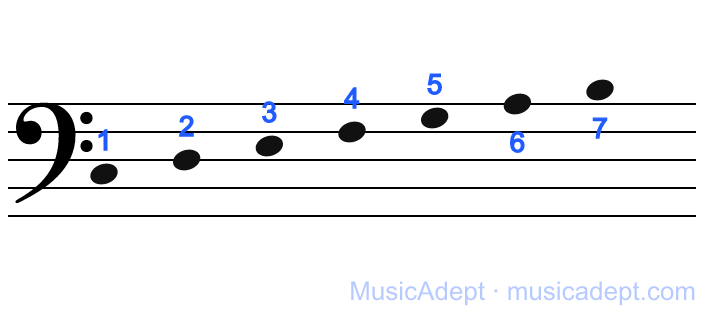
The C2 octave (lower, darker)
One octave below that is the C2 octave.
Its 1 (C2) reaches the second ledger line below the bass staff; the run climbs from there up into the bass staff. The range of the bass voice, the double bass, and the bassoon.
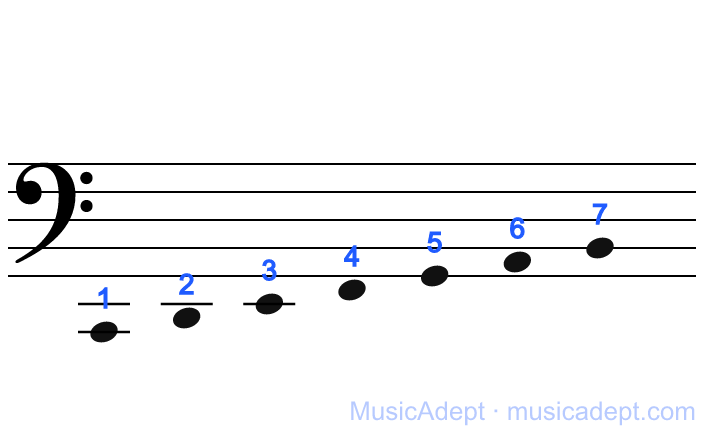
The C1 octave (the low end of the piano)
One octave lower is the C1 octave — thick and dark, the common range for the piano's left hand.
Its 1 (C1) sits many ledger lines below the bass staff — so low it's rarely written out; scores usually use 8va bassa (down an octave) to skip the stack of ledger lines. Used by the organ and the tuba.
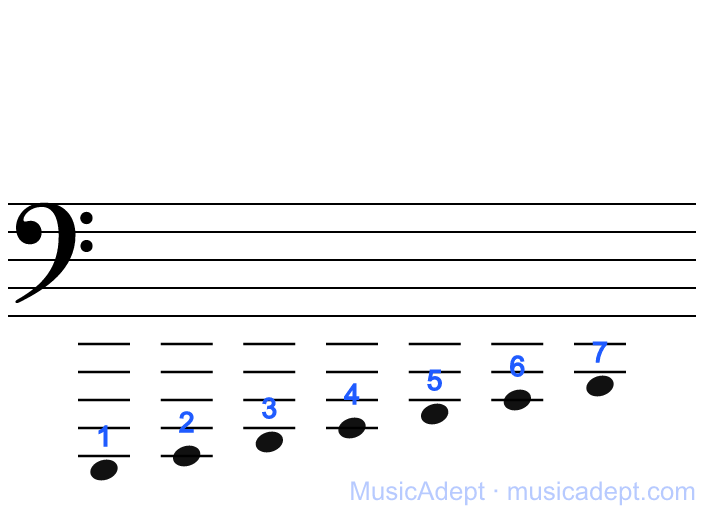
The scraps at the piano's edges
Past these, you hit the very ends of the keyboard:
- At the bottom: the piano's lowest keys are just A0, A#0, and B0 — not a full 1234567.
- At the top: the highest run starts at C7, and the piano's top note is C8.
You'll almost never need these two stretches — just file them as "the very lowest / highest end."
One line to remember
You don't have to memorize the octaves: take the C4 octave (around middle C) as your origin, count up to C5 and C6, and count down to C3 and C2. Pair that with the 6, 1, 3 anchors from the previous piece, and you can pin down any note — both which solfège degree it is and which octave it lives in.
👉 Revisit the anchor method: Read Music in 5 Minutes: Lock In 3 Notes (6, 1, 3) and Decode Every Note on the Staff