
Read Music in 5 Minutes: Lock In 3 Notes (6, 1, 3) and Decode Every Note on the Staff
Staring blankly at the staff? Stop cramming — lock in three notes (6, 1, 3) and you can work out every note: treble, bass, and ledger lines. Read the staff in 5 minutes, even from zero.
Most people get stuck trying to memorize every single line and space — five lines and four spaces, two clefs, dozens of positions. No wonder it won't stick.
You really only need three "anchor" notes: 6, 1, and 3. First, a concept that often gets skipped: 1–7 are solfège, or numbered degrees (do re mi), while C D E F G A B are note names — two naming systems for the same set of notes (C D E F G A B = 1 2 3 4 5 6 7). So in note names, 6, 1, 3 are A, C, E.
These three notes form a fixed group in every clef. Find them, and every other note is just one step up or down from the nearest anchor — treble, bass, ledger lines, all with the same trick.
How do you read the treble clef? Start by finding the 6, 1, 3 group
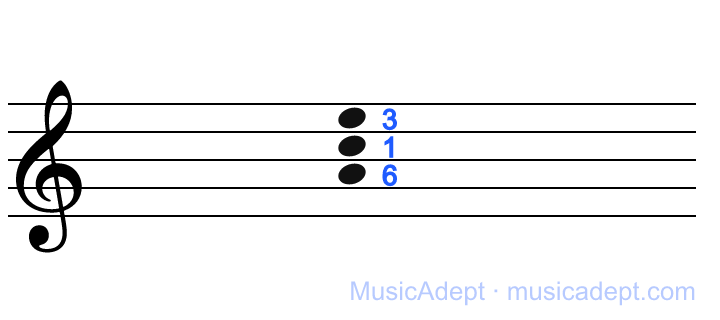
In the treble clef, the easiest 6-1-3 group lines up neatly in the spaces.
The treble staff has one ready-made 6-1-3 group.
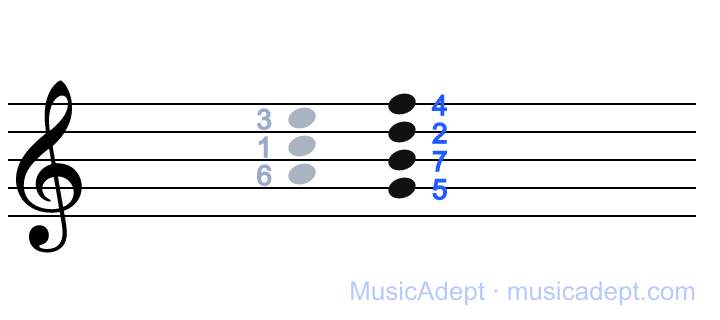
Once you have these three anchors, the notes right next to them fall into place. 6, 1, and 3 all sit in spaces, so whatever hugs them directly above or below has to be on a line:
- The line above 1 is 2
- The line below 1 is 7
- The line above 3 is 4
- The line below 6 is 5
No re-memorizing — just count up or down from the nearest 6, 1, or 3.
How do you read the bass clef? The same method, reused
The bass clef looks nothing like the treble clef, which is why many people find it harder.
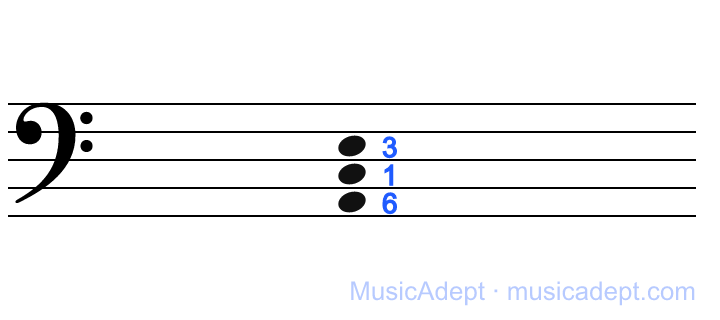
But look at it differently: the bass clef has its own clear 6-1-3 group. The rule is identical — find the anchors first, then count the neighbors. So the bass clef isn't a fresh start either.
Where is middle C? It's the bridge between the two staves
The space between the two clefs is where people get lost most. But here too you can form a 6-1-3 group.
The key one is the middle 1 — the famous middle C. Remember middle C and you have a bridge connecting the treble and bass staves.
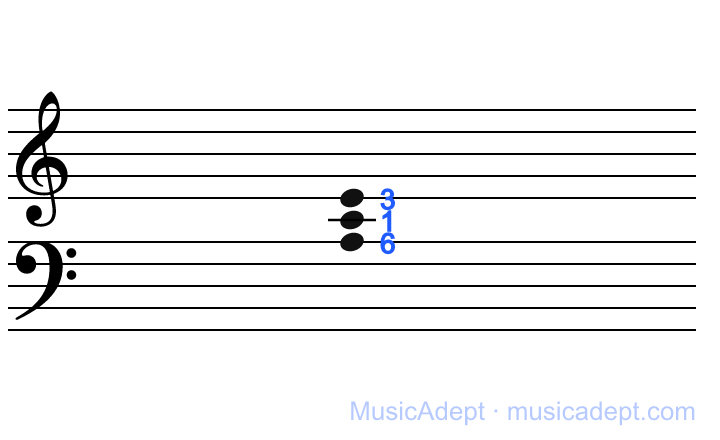
There's also a lazy shortcut hidden here: fold the staff in half along middle C, and the treble and bass staves are actually mirror images of each other. Look at the picture above — 6 and 3 land symmetrically below and above middle C (1). This symmetry repeats all over the staff, so once you know one side of middle C well, just mirror it to get the other side.
What about notes that run off the staff (ledger lines)? Still 6, 1, 3
When a note is too high or too low and runs off the staff, you use ledger lines. They look scary, but you still don't have to re-memorize anything:
- The three ledger lines above the treble staff make one 6-1-3 group.
- The three ledger lines below the bass staff, read from the bottom up, make another.
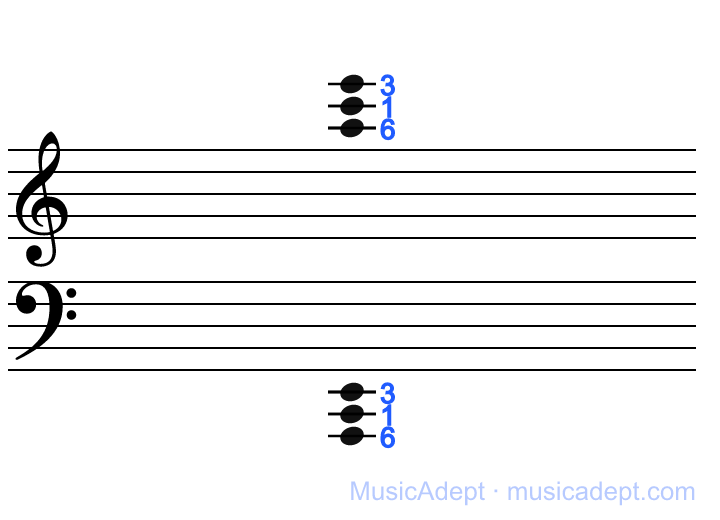
One picture: every 6, 1, 3 on the staff
By now you've found 6, 1, 3 in every area — treble, bass, the middle, and the ledger lines. The pattern never changed. Put them all on one picture and each group matches the fixed positions 6, 1, 3 = A, C, E.
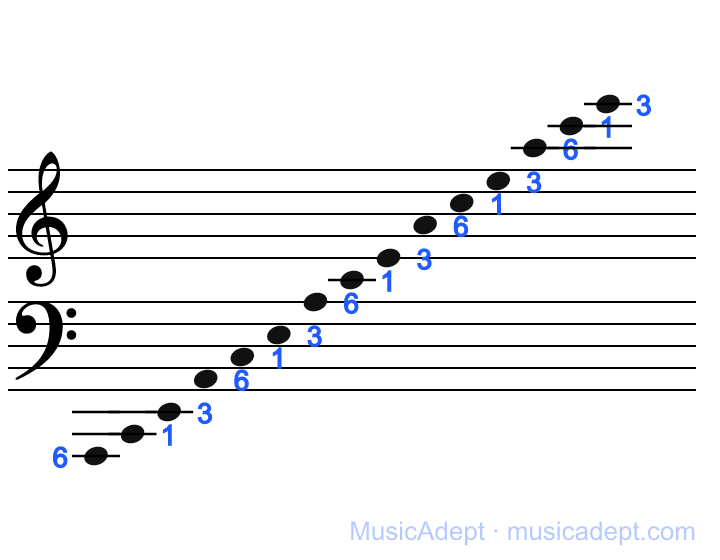
The real way to read music: name any note in three steps
From now on, when you see a note, don't rush to guess. Just three steps:
- First, place its area: treble, bass, middle, or ledger lines.
- Find the nearest 6, 1, or 3.
- Count one step up or down from that anchor — that's your note.
For example (6, 1, 3 are all in spaces, so the line touching them is your target):
- A note on the line just above 1 is 2
- A note on the line just below 3 is 2
- A note on the line just above 6 is 7
A staff isn't a heap of isolated positions — it's more like a map: 6, 1, 3 are the landmarks. Once the anchors are solid, the rest slowly comes into focus.
What's next: the same do, so why are there several?
You may have already noticed: there's a 1 in the treble staff and a 1 in the bass staff — the same do, so why are there several? That's a question of register.
👉 Read next: Same 1234567 — why so many?